Why You Still Need TGSIs on a Kerb Ramp—Even If It Meets AS1428.4.1
At Inclusify Access, we work with designers, councils, and contractors who are committed to creating public spaces that are not only compliant—but truly inclusive. One question we often hear is:
“If my kerb ramp meets AS1428.4.1, do I still need to install Tactile Ground Surface Indicators (TGSIs)?”
The short answer: Yes—unless your design meets every exemption in Appendix C.
What the Standard Actually Says
Appendix C of AS1428.4.1 outlines specific conditions under which warning TGSIs are not required. But all three conditions must be met:
The distance between the building line or boundary and the top of the kerb ramp is less than 3 metres.
The change in gradient between the pedestrian surface and the ramp surface is between 1:8 and 1:8.5.
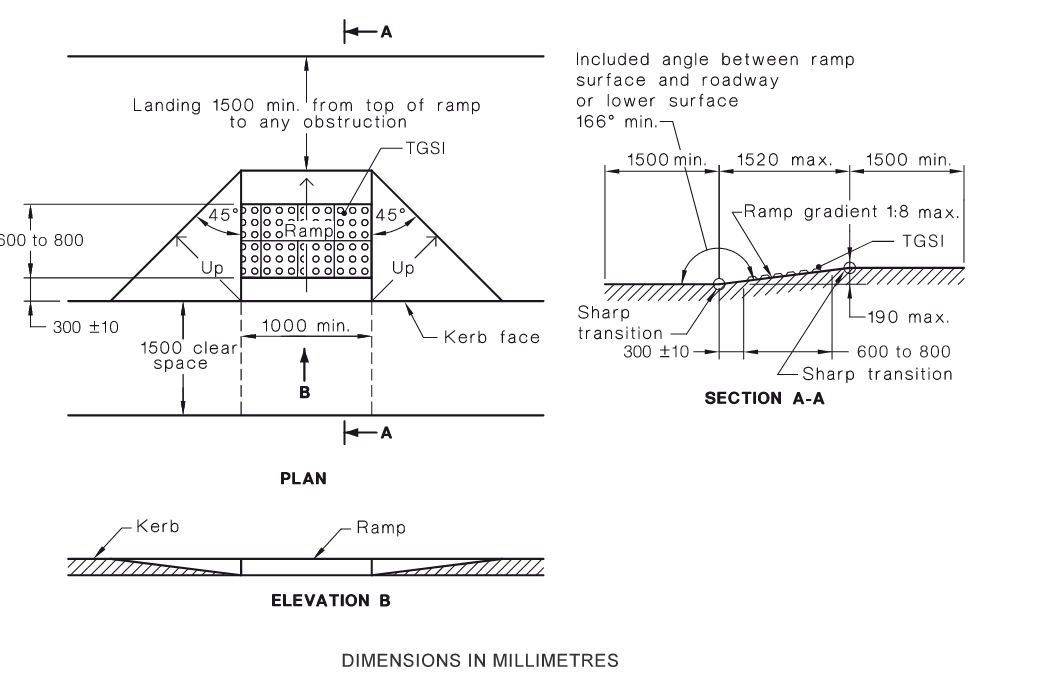
The kerb ramp is aligned with the building line and points directly across the carriageway (see Figure C2(A)).
If any one of these conditions isn’t met, warning TGSIs shall be installed.
Why TGSIs Matter
Even if your design is technically compliant, TGSIs play a vital role in making public spaces safer and easier to navigate—especially for people who are blind or have low vision.
They:
Warn pedestrians that they’re approaching a road or hazard.
Help with orientation, so users can align themselves correctly before crossing.
Create consistency across different environments, which helps people feel confident and safe.
At Inclusify Access, we see these indicators not as a checkbox—but as a commitment to inclusive design.
How They Should Be Installed
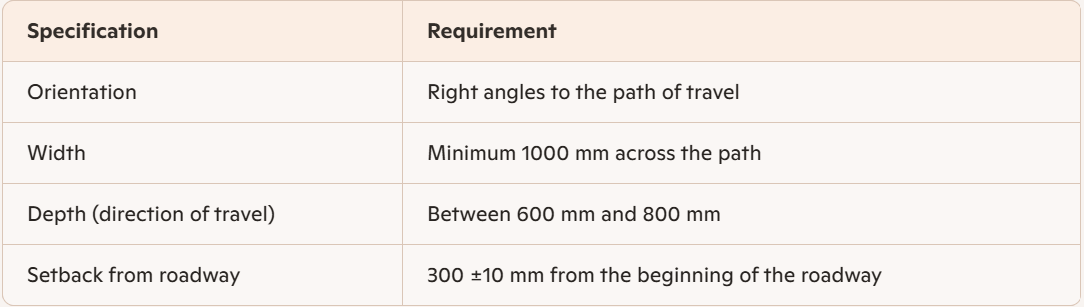
When TGSIs are required, they need to be installed properly, refer to the extract from the standard below:
These dimensions aren’t arbitrary—they’re designed to make sure the indicators are easy to detect and interpret.
Designing Beyond Compliance
Meeting AS1428.4.1 is essential—but accessibility is about more than compliance. Unless your kerb ramp meets all the exemption criteria in Appendix C, installing warning TGSIs isn’t just a requirement—it’s a commitment to inclusive design.