Small Step, Big Barrier: Why Threshold Access Matters
A tiny step at a doorway might seem inconsequential to many, but for wheelchair users, people using mobility aids, or anyone pushing prams or trolleys, it can present a major obstacle. Even a 20–30 mm threshold can interrupt a smooth journey, creating frustration, risk of falls, or dependence on others.
This is where threshold ramps come in. Specifically designed to bridge small level changes—up to 35 mm—they provide safe, smooth, and inclusive transitions without interfering with door operation. In other words, they turn a “small step” into a universally accessible entrance.
What does the Standards say (AS1428.1-2021)?
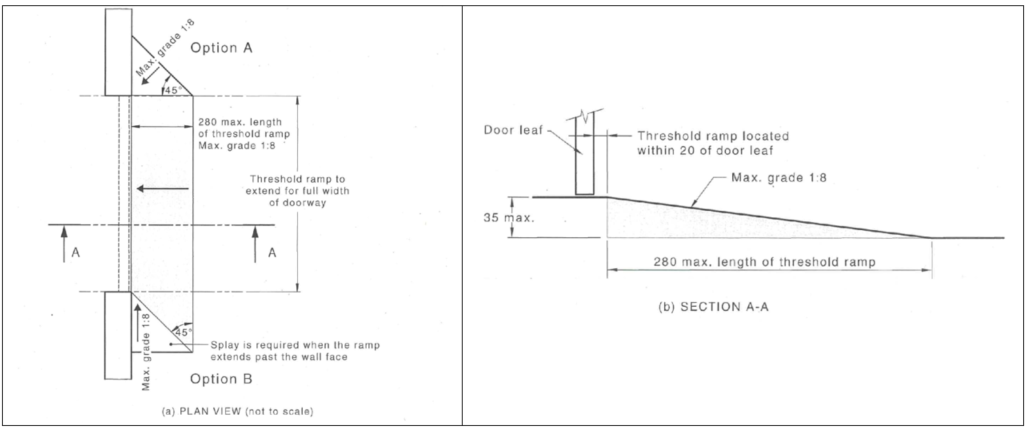
Threshold ramps at doorways on a continuous path of travel shall have —
(a) a maximum rise of 35 mm;
(b) a maximum length of 280 mm;
(c) a maximum gradient of 1:8; and
(d) be located within 20 mm of the door leaf which it serves, as shown in Figure 21.
(e) sharp transition at top and bottom; and
(f) sharp transition at tapered or splayed edges.
The edges of the threshold ramp shall be tapered or splayed at a minimum of 45° where the ramp does not abut a wall. Splay is required when the ramp extends past the wall face.
Seemingly minor design choices can have a big impact. By addressing threshold access, we improve:
Safety: Reducing tripping hazards and ensuring wheels don’t get caught.
Independence: Allowing users to move freely without relying on assistance.
Inclusivity: Creating spaces that can be used by everyone, regardless of mobility.
Compliance: Meeting regulatory requirements while enhancing practical accessibility.