Key Updates in Stair Nosing Requirements: AS 1428.1-2009 vs AS 1428.1-2021
Stair nosing strips play a critical role in accessibility, providing tactile and visual cues to help all users, especially those with vision impairment, navigate steps safely. The Australian Standard AS 1428.1 sets out the requirements for these nosing strips, and the 2021 update introduces some subtle but important refinements compared to the 2009 version. Here’s a detailed comparison to help designers, builders, and accessibility consultants stay informed.
Key Differences
| Feature | AS 1428.1-2009 | AS 1428.1-2021 |
|---|---|---|
| Contrast strip style | Single, continuous colour strip only. No multi-colour or patterned strips. | Single, continuous colour strip only. No multi-colour or patterned strips. |
| Width of strip | 50–75 mm wide across the full width of the path of travel. | 50–75 mm wide across the full width of the path of travel. |
| Setback from front edge | Up to 15 mm setback from the step edge. | Up to 15 mm setback from the step edge. |
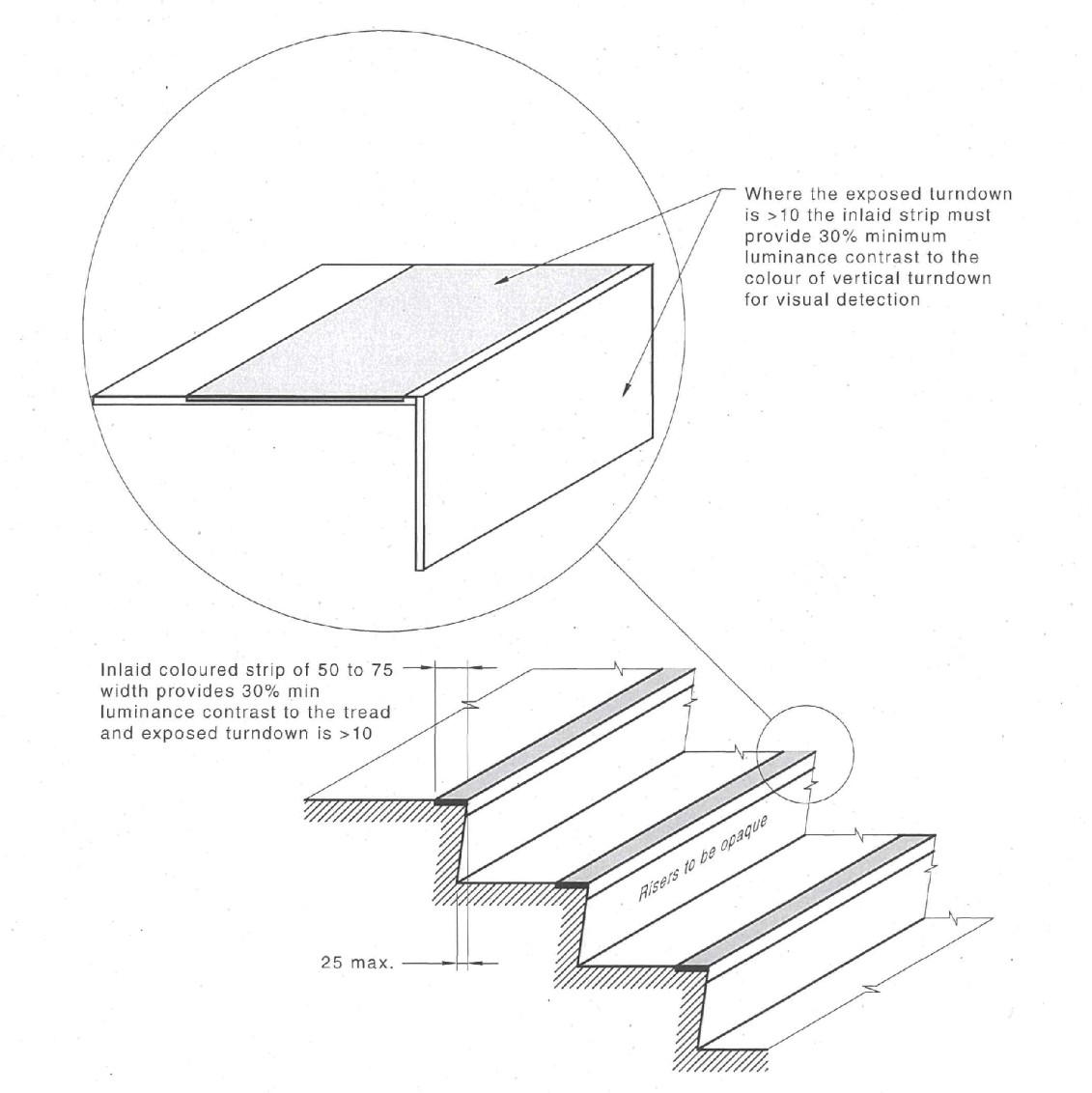
| Vertical extension on riser | Max 10 mm downward if positioned at the front edge. | Same limit—unless the nosing blends in visually, then extension can exceed 10 mm. |
| Luminance contrast | Minimum 30% contrast between strip and background. | Same, but now also applies to vertical face if it’s over 10 mm deep. |
| Visual guidance | Basic diagrams. | More detailed diagrams, including complex nosing profiles (e.g., Figure 27 C). |
| Slip resistance |
P3 for Dry Surface (Internal Stairs) P4 for Wet Surface (External Stairs) |
P3 for Dry Surface (Internal Stairs) P4 for Wet Surface (External Stairs) |
- Consistency in core dimensions and slip requirements
The width, setback, and slip resistance requirements remain largely unchanged, ensuring continuity for projects already designed under AS 1428.1-2009. - Expanded guidance on vertical extension
The 2021 standard allows a nosing to extend beyond 10 mm downward if it visually blends with the step, giving designers more flexibility without compromising safety. - Enhanced luminance contrast requirements
Luminance contrast now applies to vertical faces deeper than 10 mm, ensuring improved visibility from different angles and helping users better detect step edges. - Improved visual diagrams
The updated standard includes detailed diagrams that cover more complex nosing profiles, making it easier for designers to specify compliant solutions accurately. - No change in colour or pattern restrictions
Continuous single-colour strips remain mandatory, preserving the simplicity and clarity essential for accessibility.
Conclusion
While the differences between AS 1428.1-2009 and AS 1428.1-2021 may seem subtle, they provide important clarifications that can improve safety and visual guidance on stairs. For architects, builders, and accessibility consultants, understanding these updates ensures compliance and enhances inclusivity in public and private spaces.