
A building that looks straightforward to use can still create barriers for people with different access needs. A building access audit helps identify where access works well, where barriers may arise and what the findings mean for the property.
Property owners and managers need more than a technical list of issues. They need to understand the purpose and limits of an audit, and how to use its findings to plan practical next steps. An audit is a diagnostic assessment: it identifies access considerations and supports planning, but it does not carry out building work or guarantee an outcome.
This guide explains what a building access audit may assess, how to prioritise findings in the context of a building’s needs and constraints, and how professional access advice can help turn technical considerations into considered decisions. A clearer view of barriers and options can support more informed asset planning and inclusive building use.
Key Takeaways
- A building access audit assesses access conditions against relevant criteria. It is not construction work or a guarantee of compliance.
- Reviewing the journey from the site approach through entry, circulation and facilities can help reveal where barriers arise.
- Audit findings depend on the agreed scope, available evidence and the building’s circumstances.
- Turn findings into a considered plan by weighing access impact, feasibility, project dependencies and building operations.
- Disability access audits and detailed reports can help property stakeholders interpret issues and plan practical next steps.
Why a building access audit matters across a property’s lifecycle
A building’s access needs can change as its use, occupants and surroundings evolve. A structured assessment helps property stakeholders understand how people with varied disability access needs may experience the building, and where barriers could affect entry, movement or use of facilities. Findings can inform decisions at different stages of an asset’s life, from early planning to ongoing facility management.
A building access audit is a systematic assessment of a property’s access conditions against relevant criteria. It identifies barriers and informs decisions, but does not replace a checklist, carry out building work or guarantee compliance. Checklists can organise observations, but an audit interprets conditions in context: how the building is used, who uses it, what was assessed and which criteria apply. Broader accessibility principles also frame access as a practical part of participation, rather than a single design feature.
When can a building access audit inform property decisions?
An assessment can be useful during asset planning, before proposed upgrades are designed, or as part of ongoing facility management. Early findings can bring access considerations into a project brief while design options are still being developed, rather than after key decisions are fixed. An audit may also help managers understand how existing conditions relate to planned maintenance or a change in building use. These are opportunities to inform decisions, not automatic triggers for a legally required audit.
Who uses audit findings, and what decisions can they support?
Owners, developers, facility managers and organisations responsible for building use can draw on findings for different purposes. An owner may use them to shape asset priorities, a developer may consider them when preparing a project brief, and a facility manager may use them to inform maintenance planning or staged improvements. The value comes from translating observations into clear considerations, not treating every finding as the same kind of project.
For example, a report might identify an access issue to consider alongside planned works, operational constraints or the needs of people who use the building. Stakeholders can then assess:
- Which findings have the greatest effect on access and inclusion.
- Whether a response depends on another planned project or building operation.
- How potential improvements could be sequenced and reviewed.
Priorities depend on the property, its users, the assessment scope and applicable requirements. A building access audit can provide a basis for discussion and planning, while decisions about scope, timing and response remain with the responsible stakeholders. Inclusify Access provides disability access audits and detailed reports to help property stakeholders interpret access issues and plan considered next steps.
How a building access audit examines the experience of moving through a building
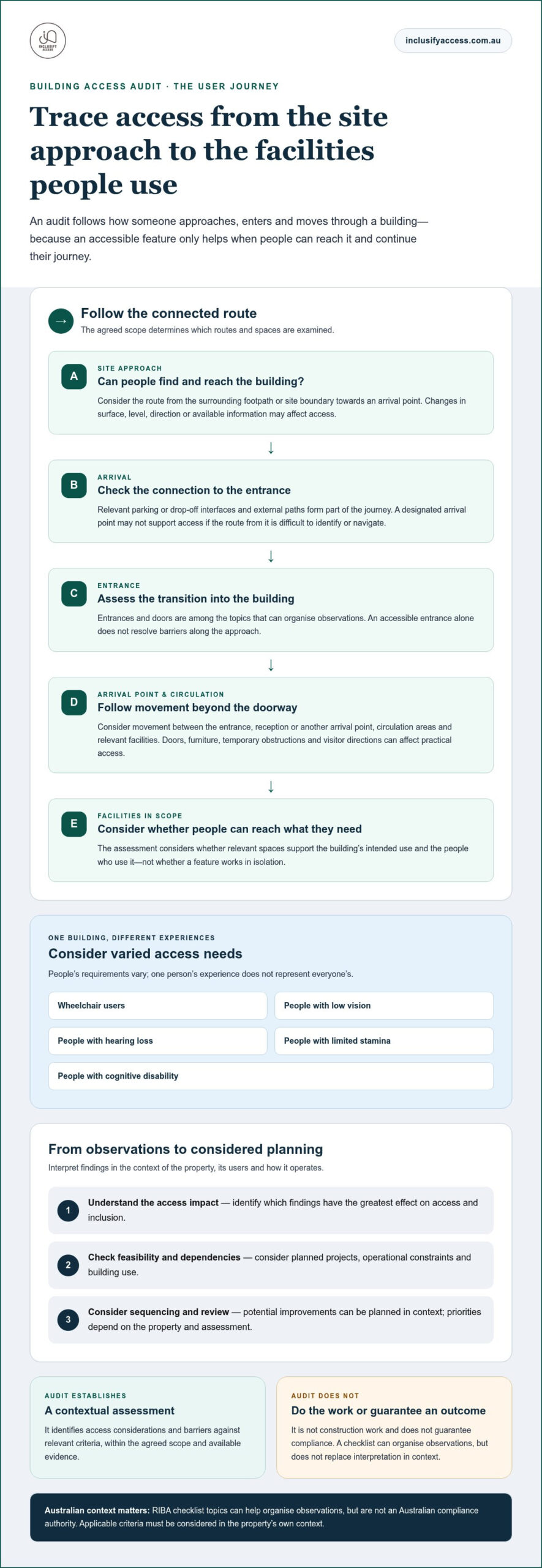
Access is experienced as a journey, not as a collection of separate features. A building access audit can trace how a person approaches the site, arrives, enters, moves through the building and reaches facilities relevant to its use. Following that route helps reveal whether a feature that appears accessible in isolation connects with the rest of the journey.
People’s requirements vary. A person using a wheelchair may encounter different barriers from someone with low vision, hearing loss, limited stamina or cognitive disability. An assessment considers these differences without assuming one person’s experience represents everyone’s. The property, agreed assessment criteria and purpose of the audit shape which routes and spaces are examined.
Following access from the site boundary to the entrance
Consider the route from the surrounding footpath or site boundary to an arrival point, including relevant parking or drop-off interfaces, external paths and the entrance. Changes in surface, level, direction or available information may affect whether someone can find and reach the building. An accessible entrance alone does not resolve barriers along the approach.
RIBA checklist topics, including external routes, parking, ramps, steps, entrances and doors, can help organise observations. They are a reference for recording areas to consider, not an Australian compliance authority. The applicable criteria for an Australian property must be considered in its own context.
A connected route matters because an accessible feature is useful only when people can reach it and continue to the spaces they need. For instance, a designated arrival point may not support access if the path from it to the entrance is difficult to identify or navigate.
Considering circulation and use beyond the entrance
Once inside, an assessment can consider how people move between the entrance, reception or another arrival point, circulation areas and relevant facilities. The aim is not to apply a generic checklist to every building, but to understand whether the spaces in scope support the building’s intended use and the people who use it.
Operational context matters. Doors, furniture, temporary items that obstruct circulation, and the way visitors are directed to a service can all affect practical access. These details may matter even when the underlying building feature seems adequate. Assessment observations should be interpreted alongside how the property functions day to day.
The agreed scope establishes which routes, spaces and user experiences the report can address, and where further consideration may be needed. Inclusify Access provides disability access audits and reports to help property stakeholders interpret findings in context. For an assessment of a property’s access journey, explore Inclusify Access disability access audits.
What an access audit can establish, and what it cannot guarantee
Commissioning a building access audit does not, by itself, make a property compliant. An audit provides evidence and professional advice within an agreed scope; it does not complete building work, secure approvals or certify that every access issue has been resolved. Its value is in clarifying what was assessed, what the findings indicate and which decisions remain.
Conclusions depend on the criteria used, areas included, information available and the building’s circumstances. An observation, such as a route being obstructed during an inspection, can be recorded as evidence. Assessing its implications requires professional judgement, while deciding how and when to respond involves project and operational considerations.
How do access requirements relate to an audit?
Australian access considerations may involve the Disability Discrimination Act 1992 (DDA), the Disability (Access to Premises, Buildings) Standards 2010, the National Construction Code (NCC) and relevant Australian Standards. These instruments have distinct roles, and their application depends on matters such as the building, proposed work and assessment purpose. Current requirements and jurisdictional provisions should be verified for each project. General information in this article is not legal advice.
Why doesn’t an audit amount to a blanket compliance guarantee?
An assessment records findings against its agreed criteria and scope. It may not address every space, use or changing operational condition, and a report cannot establish that recommendations have been implemented. Building approvals and other project decisions are separate matters. Read the report as a defined assessment, not as a universal statement covering every access, operational or legal issue.
The distinction between evidence, advice and decisions is useful when interpreting findings:
Audit evidence: Recorded observations and information about the areas assessed, considered against the stated criteria.
Resulting advice: Professional interpretation of those findings, including access issues or options that may warrant further consideration.
Separate decisions: Choices about design, works, timing, approvals, operational changes and implementation, made in the context of the property and applicable requirements.
A report may identify an issue and explain its significance, but the appropriate response can depend on building constraints, planned projects and how the space is used. If a proposed response involves a complex design challenge, a performance solution may be relevant under the NCC, subject to the project circumstances and applicable requirements. This does not make an audit an approval or guarantee.
Clear reporting helps stakeholders understand both the reach and limits of an assessment. Inclusify Access prepares detailed access reports to support property decisions, with findings grounded in the defined assessment and the building’s circumstances.
Turning building access audit findings into a workable improvement plan
Findings become useful when they lead to clear decisions, assigned responsibility and follow-up. A building access audit report can inform an improvement plan, but the plan should reflect how the property operates, who uses it and which projects are already under consideration. A considered sequence helps teams move from observations to agreed actions without assuming every response can happen at once.
- Understand the findings. Read each observation alongside its location, supporting evidence, assessment criteria and any recommendation. Clarify what the report establishes and what may need further investigation.
- Assess the context. Consider the affected route or activity, building use, operational constraints and relevant project dependencies.
- Set priorities. Compare the likely effect on access with feasibility and opportunities to coordinate action with planned works.
- Plan actions. Record the agreed response, who is responsible for progressing it and how it relates to other property decisions.
- Review outcomes. Revisit actions as the building, its use or project circumstances change, and record what has been completed or remains under consideration.
A prioritised action plan is a practical sequence for managing improvements, not a promise of instant compliance. It gives owners, managers and project teams a shared reference for discussion while keeping decisions grounded in the building’s circumstances.
How should property teams prioritise audit findings?
Group findings by their effect on access and the part of the building journey they affect. Then consider each alongside feasibility, operational demands and project context. A matter affecting access to a frequently used service may call for different planning from an issue tied to a future upgrade. There is no universal ranking formula: priorities should be reasoned, documented and appropriate to the property.
Dependencies can affect sequencing. An agreed response may relate to another project, require coordination with building operations or need additional assessment before a decision. Recording these links helps teams distinguish actions that can be considered independently from those that depend on wider planning.
How can teams keep findings useful after the initial assessment?
Assign responsibility for reviewing recommendations and maintaining a record of agreed actions, decisions and outstanding considerations. This gives property and project teams a common reference as work is planned or building operations change. The record can also explain why an action was staged, deferred or linked to another project, without implying that a recommendation has been implemented.
Revisit findings when building use, layouts, works or applicable requirements change, since earlier observations may need to be reconsidered in the new context. Teams preparing for an assessment can use a guide to how to prepare for an access audit to organise relevant property information in advance.
Inclusify Access prepares access reports to help stakeholders interpret findings and plan considered responses. Discuss your access audit findings as part of a practical improvement-planning process.
How Inclusify Access supports building access audits and next steps
Each property has its own purpose, layout and operational context, so access advice needs to relate to the decisions its stakeholders are making. Inclusify Access is an Australian consultancy providing disability access audits and detailed access reports for properties. Its assessment and reporting help owners, developers and facility managers understand identified access issues in relation to their building and project objectives.
A building access audit can provide a considered basis for planning, whether a team is reviewing an existing asset, preparing for proposed upgrades or interpreting complex findings. The assessment scope and reporting are shaped around the property and purpose of the work, helping stakeholders distinguish what has been observed from matters that require further discussion or a separate project decision.
What can project-specific access advice contribute?
Tailored assessment considers the building’s circumstances and the objectives of the people responsible for it. A clear report sets out relevant findings to support informed planning. Owners can consider asset priorities, developers can develop project briefs, and facility managers can relate recommendations to building operations. This gives stakeholders a more useful basis for deciding what to investigate or plan next.
Where an access challenge is complex, a performance solution may be a potential pathway under the NCC, subject to the project’s circumstances and applicable requirements. It is not a predetermined outcome, approval or guarantee of compliance. The advice needs to be considered within the relevant technical and regulatory context.
When should a property team seek support?
Access advice can be useful when a team is planning upgrades, reviewing an existing asset or working through findings that are difficult to interpret. Early collaboration brings access considerations into discussion before project decisions are finalised, helping the team understand potential constraints and dependencies while options are still being considered. It can also help stakeholders frame the questions that need to inform their next steps.
The appropriate scope depends on the property, its use and the decision at hand. A focused discussion of those factors can help establish what assessment or reporting would support the work, without presuming a particular compliance outcome.
If you’re considering an assessment or need help interpreting existing findings, discuss a building access audit with Inclusify Access as part of your property planning.
Planning the next step towards inclusive building use
Inclusive access is an ongoing part of responsible property stewardship. As a building’s use, occupants or planned works change, access considerations can be brought into asset discussions early, helping teams make informed choices that support the people who rely on the space.
A building access audit can give your team a clearer basis for its next decision. Inclusify Access provides disability access audits, access reviews and detailed reports for building approvals and facility management. Where a project presents a complex architectural challenge, performance solutions may also be considered in line with applicable NCC requirements. The right support depends on the property and the question your team needs to address.
Whether you’re reviewing an existing building or shaping an upcoming project, a considered conversation can help clarify the assessment or advice that would be useful. Discuss a building access audit with Inclusify Access and take a practical next step towards more inclusive building use.
Frequently Asked Questions
What is a building access audit?
A building access audit is a structured review of a property’s access conditions against relevant criteria. It helps clarify how features and routes function for people with different access needs, and records issues for the property team to consider. For example, an assessment might consider whether a visitor can reach the service area relevant to their appointment. The agreed scope determines which parts of the property and which questions the findings address.
Is a building access audit legally required in Australia?
Whether an audit is required depends on the property, its use, proposed work and applicable legal requirements. The Disability Discrimination Act 1992, Premises Standards, National Construction Code and relevant Australian Standards may inform decisions, but their application is not identical for every building or project. A practical first step is to identify the building’s circumstances and planned works, then obtain project-specific advice on applicable obligations rather than rely on a general answer.
Can an access audit guarantee that a building complies?
No. An audit reports only on the agreed assessment scope and criteria, so it should not be treated as proof that every aspect of a property meets every requirement. For instance, a review of selected public areas does not automatically establish the status of areas outside that scope. Compliance considerations can also depend on later design choices, completed work and current requirements. Use the report as decision-support information, not as approval or certification.
Who can benefit from a building access audit?
Owners, developers, facility managers and organisations responsible for buildings can use audit findings to inform decisions. A facility manager might draw on observations when preparing maintenance priorities, while a developer could consider access in a project brief. The value depends on relating findings to the people who use the building and its intended function. An audit informs those responsible; it does not transfer their decision-making or implementation responsibilities.
When should a building access audit be considered?
Consider an assessment when reviewing an existing asset, planning an upgrade, changing how a space is used or preparing an improvement plan. For example, before finalising a project brief, a team may want to understand whether proposed changes affect how people enter or use key areas. Considering access early keeps it in view while options are being developed. Suitable timing depends on the property’s condition, purpose and planned decisions.
What happens after a building access audit?
Property teams can use the findings to decide what needs further investigation, which recommendations to consider and how proposed actions relate to other work. A practical record might note the relevant report finding, the agreed next step, who is responsible for progressing it and any project dependency. Teams can then update that record as decisions are made. The assessment itself does not carry out changes, so follow-through remains a separate part of property management.
How often should a building access audit be repeated?
There is no single repeat interval that suits every property. A review may be worth considering after a change in use, a revised layout, completed works or a change to relevant requirements. For example, converting an area to a new service function may alter which routes and facilities matter to users. Keeping earlier reports and decisions together can help a later assessment identify what has changed and where further review may be useful.